


- Cite
- title.'." Accessed '.date('F j, Y').'. http://'.$_SERVER["HTTP_HOST"].$_SERVER["REQUEST_URI"]; ?>
- Share
- title.' '.$node_url) > 140 ? substr($node->title, 0, (136 - strlen($node_url))).'...' : $node->title).' '.$node_url).'" title="Tweet this article" target="windowName" onclick="window.open(this.href,this.target,"width=500,height=500"); return false;">
 Twitter';
?>
Twitter';
?>  Facebook';
?>
Facebook';
?>
- title.' '.$node_url) > 140 ? substr($node->title, 0, (136 - strlen($node_url))).'...' : $node->title).' '.$node_url).'" title="Tweet this article" target="windowName" onclick="window.open(this.href,this.target,"width=500,height=500"); return false;">
- Print this Page
On November 8, 1862, Sibley and his military forces began the journey to move the 303 condemned men from the Lower Sioux Agency to a prison camp in Mankato where the executions were to take place. The prisoners, shackled together in horse-drawn wagons, were attacked by a mob on the outskirts of New Ulm on November 9. Two of the prisoners later died of their injuries. Sibley arrested several New Ulm men, accusing them of coordinating the attack and forcing them to accompany the convoy to Mankato in order to prevent further violence against the prisoners. Then he made them walk home.
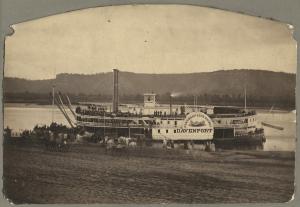
On April 22, 1863, the prisoners convicted by the military commission who had been imprisoned at Mankato but were spared execution were sent by steamboat to a military prison in Davenport, Iowa. At least 120 Dakota men died during their imprisonment at Davenport.
 I have learned that orders have been issued to convey all the Indians who have not been convicted to the neighborhood of Ft. Snelling. They will probably take up their march tomorrow. The men who have been convicted are to be taken to Mankato for what disposal is not made known.
It is a sad sight to see so many women & children marching off--not knowing whether they will ever see their husbands & fathers again.
John P. Williamson, in a letter to S. B. Treat, November 5, 1862
For six days beginning November 7, 1862, about 1,700 Dakota people (mostly women and children) who had not been sentenced to death or prison were removed from the Lower Agency to Fort Snelling, under the protection of Lt. Col. William R. Marshall. In speaking to the press before leaving the agency, Marshall said:
I would risk my life for the protection of these helpless beings, and would feel everlastingly disgraced if any evil befell them while in my charge. . . . I want the settlers in the valley . . . to know that they are not the guilty Indians . . . but friendly Indians, women, and children.
From the St. Paul Daily Press, Nov. 8, 1862
But as the train of wagons and riders passed through Henderson, Minnesota, they were attacked by what Samuel J. Brown later called an "angered mob . . . cursing, shouting, and crying."
Men, women, and children, armed with guns, knives, clubs, and stones, rushed upon the Indians as the train was passing by, and, before the soldiers could interfere and stop them, succeeded in pulling many of the old men and women, and even children, from the wagons by the hair of the head and beating them, and otherwise inflicting injury upon the helpless and miserable creatures.
Brown called the settler mob "as bad as Savages," and wrote that he witnessed "an enraged white woman . . . snatch a nursing babe from its mother's breast and dash it violently to the ground." The baby was returned to its mother, but it later died and its body was "quietly laid away in the crotch of a tree," according to Dakota custom.
Brown also recalled another incident at Henderson:
As the train was passing through the town one of the citizens with blood in his eyes and half crazed with drink rushed up with a gun levelled at Charles Crawford [Samuel Brown's uncle], one of the friendlies, and was about to fire, when "the bold charger of the plains," Lieut. Col. Marshall, who happened along on horseback rushed between them and struck down the gun with his sabre and got Crawford out of the way, thus saving a life at the risk of his own.
Samuel J. Brown, "In Captivity" recollections, 1897
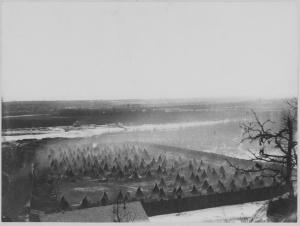
The survivors and their military escorts reached the Ft. Snelling area on November 14, and set up camp at the first of what eventually became at least four different "Indian camps" at the Fort between the end of 1862 and May 1863. The largest and best known camp--and the only one for which a photograph still exists (see above)--was on the river flats below the Fort. The Dakota spent the winter at this camp. Estimates of deaths in the camp range from 102 to 300, most due to outbreaks of measles and other diseases that were also sweeping through St. Peter and other communities where war refugees were gathered.
Amid all this sickness and these great tribulations, it seemed doubtful at night whether a person would be alive in the morning.
Tiwakan (Gabriel Renville), a Sisseton Dakota held at the Ft. Snelling internment camp
In May 1863, the interned Dakota--along with about 2,000 Ho Chunk who had had no part in the war--were loaded onto steamboats and moved to a camp at Crow Creek, in present-day South Dakota.
Morton Enterprise, January 29, 1909.
Riggs, Stephen Return. Mary and I: Forty Years with the Sioux. Williamstown, MA: Corner House, 1971.
Bakeman, Mary Hawker and Antona M. Richardson, eds., Trail of Tears: Minnesota's Dakota Indian Exile Begins, Roseville MN: Prairie Echoes Press, 2008
Samuel J. Brown, "In Captivity: The Experience, Privations and Dangers of Sam'l J. Brown, and Others, while Prisoners of the Hostile Sioux, during the Massacre and War of 1862," Mankato Weekly Review, April 6, 13, 20, 27, May 4, 11, 1897. Excerpted in Through Dakota Eyes: Narrative Accounts of the Minnesota Indian War of 1862, Gary Clayton Anderson and Alan R. Woolworth, St. Paul: MHS Press, 1988.
Primary
Monjeau-Marz, Corinne L. The Dakota Indian Internment at Fort Snelling, 1862-1864. St. Paul: Prairie Smoke Press, 2006.
Morton Enterprise, January 29, 1909.
Riggs, Stephen Return. Mary and I: Forty Years with the Sioux. Williamstown, MA: Corner House, 1971.
U.S.-Dakota War Oral History Project. Minnesota Historical Society.
Samuel J. Brown, "In Captivity: The Experience, Privations and Dangers of Sam'l J. Brown, and Others, while Prisoners of the Hostile Sioux, during the Massacre and War of 1862," Mankato Weekly Review, April 6, 13, 20, 27, May 4, 11, 1897. Excerpted in Through Dakota Eyes: Narrative Accounts of the Minnesota Indian War of 1862, Gary Clayton Anderson and Alan R. Woolworth, St. Paul: MHS Press, 1988.
Secondary
Waziyatawin. In the Footsteps of Our Ancestors: The Dakota Commemorative Marches of the 21st Century. St. Paul: Living Justice Press, 2006.
- Cite
- title.'." Accessed '.date('F j, Y').'. http://'.$_SERVER["HTTP_HOST"].$_SERVER["REQUEST_URI"]; ?>
- Share
- title.' '.$node_url) > 140 ? substr($node->title, 0, (136 - strlen($node_url))).'...' : $node->title).' '.$node_url).'" title="Tweet this article" target="windowName" onclick="window.open(this.href,this.target,"width=500,height=500"); return false;">Twitter';
?>
- Facebook';
?>
- title.' '.$node_url) > 140 ? substr($node->title, 0, (136 - strlen($node_url))).'...' : $node->title).' '.$node_url).'" title="Tweet this article" target="windowName" onclick="window.open(this.href,this.target,"width=500,height=500"); return false;">
- Print this Page

